
English pamphlet
The Court’s judicial work
The Supreme Court of Canada is Canada’s highest court. It serves Canadians by deciding legal issues of public importance, which contribute to the development of all branches of law in Canada. The Court is bilingual, meaning it works and decides cases in English and French. It is also bijural, meaning it decides cases from Canada’s two legal traditions, common law and civil law. The Court hears cases in all areas of the law, including constitutional law, administrative law, criminal law and private law.
In most cases, a party who wants to appeal the decision of a lower court must get permission, or leave to appeal, from the Court. The Supreme Court will only hear cases that the judges consider to be of public importance.
Decisions of the Court do not need to be unanimous. A majority of judges may decide and the minority will give dissenting reasons. Each judge can write reasons in any case if they choose to do so. Judgments are published simultaneously in both official languages. In some cases, the Court will give its decision orally at the end of a hearing, but most of the time it reserves judgment to allow the judges to write detailed reasons.
The Supreme Court holds three sessions a year. Sessions last three months each and take place in the fall, winter and spring. The Court generally sits Monday to Friday, starting at 9:30 am and hearings are open to the public. Check the online hearing schedule to see when the Court is in session and to reserve a seat in the courtroom.
History
The Supreme Court of Canada was established in 1875, more than 100 years after the first courts appeared in present-day Canada. Today, the Court stands as the final court of appeal in the Canadian judicial system.
The Court was originally composed of six judges. In 1927, the number of Supreme Court judges was raised to seven, and the Court reached its present total of nine members in 1949. Of the nine judges, the Supreme Court Act requires that three be appointed from Quebec.
Traditionally, the Governor in Council appoints three judges from Ontario, two from the Western provinces or Northern Canada and one from the Atlantic provinces. Any superior court judge or lawyer of at least 10 years’ standing at the bar of a province or territory can be appointed as a judge of the Supreme Court of Canada. Supreme Court judges sit until they retire or reach 75 years of age.
A home for the Court
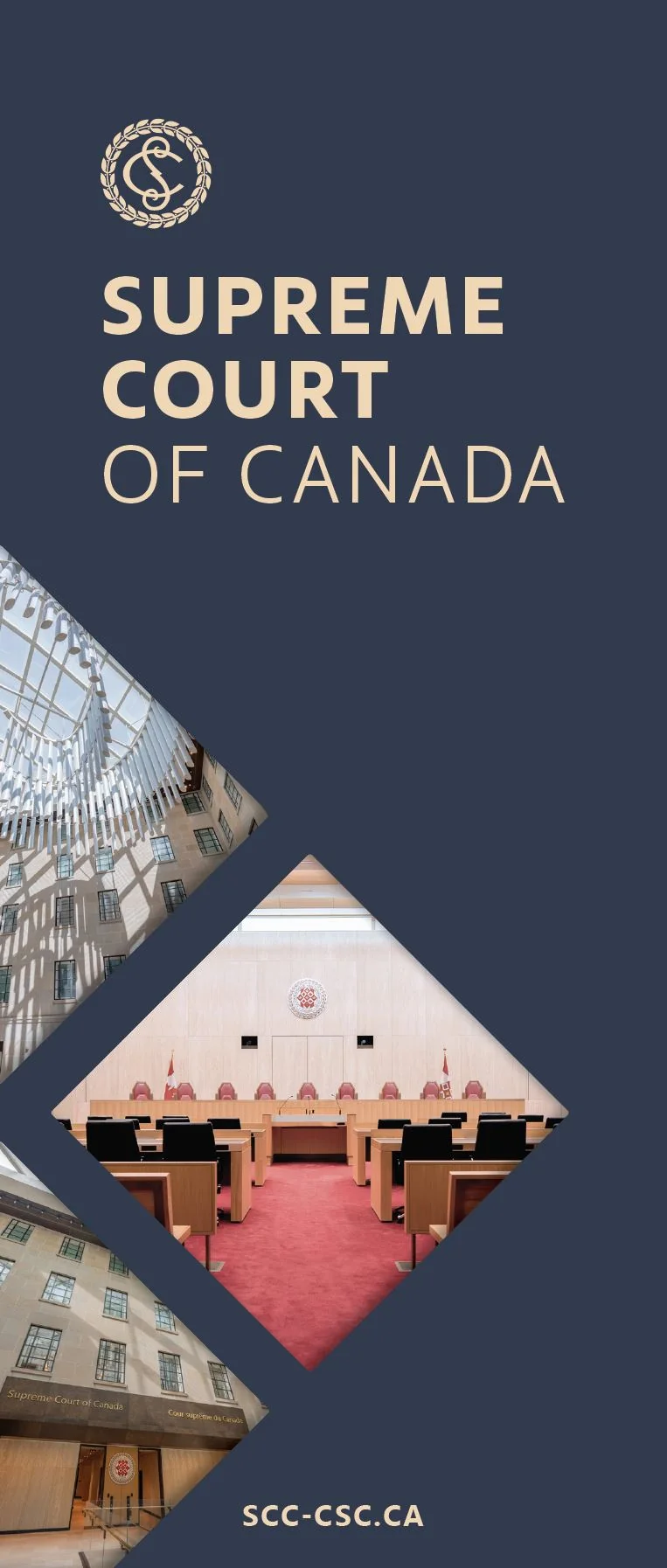
The Court first sat in the Parliament buildings before moving, in 1882, to its own small two-storey building at the foot of Parliament Hill, which it occupied until 1946. That year, the Court relocated to its permanent home at 301 Wellington Street, a building designed by renowned Montréal architect Ernest Cormier. Since the summer of 2026, the Court has been temporarily housed in the West Memorial Building at 344 Wellington Street while its permanent home undergoes long-term restoration.
The West Memorial Building was built between 1954 and 1958 to commemorate Canadians who died in the Second World War. An arch spans Lyon Street between the East Memorial Building and the West Memorial Building. Both buildings were designed by the architectural firm Allward & Gouinlock.
No matter where it sits, the Supreme Court of Canada continues to have a significant impact on the rule of law and the evolution of our country.
Did you know?
Opening hours
September to April
9 am to 5 pm, Monday to Friday
Guided tours are offered by reservation only.
May and June
9 am to 5 pm daily
Guided tours are offered by reservation only from Monday to Friday.
Guided tours are offered without a reservation on Saturday and Sunday.
July and August
9 am to 5 pm daily, including weekends and holidays.
Guided tours are offered throughout the day.
Remote tours are also available.
Contact us
Tour information and reservations
Email: tour-visite@scc-csc.ca
Tel: 613-995-5361
Toll-free: 1-866-360-1522
General inquiries
Email: reception@scc-csc.ca
Tel: 1-888-551-1185
The Supreme Court of Canada
344 Wellington Street
Ottawa ON, K1A 0J1